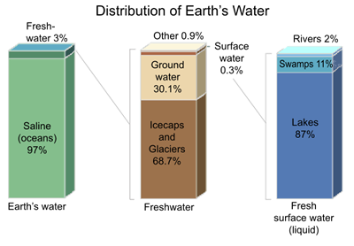
Water Distribution and Uses The majority of the earth is covered is in water and a whopping 97% of that water is saline water in the oceans. The freshwater makes up only 3% of earth's water and of that 69% is is the form of glaciers and ice caps found mainly in Greenland and Antartica. Of the freshwater remaining, most is stored beneath our feet as ground water. Only approximately .3% of that is contained in rivers and lakes which is where our everyday water comes from. Surface water is used mainly for drinking and irrigation. Besides filling our rivers and lakes, groundwater provides water for those who live in areas where visible (surface) water is not readily available. These are desert areas of the Western States. Water Uses |
||
 Categories of Use Commercial - includes freshwater for restaurants, hotels and all other commercial facilities along with military and civilian institutions. Domestic - includes use in the home for everyday and normal household purposes such as cooking, bathroom uses, washing dishes and clothes, cleaning, watering lawns and so on. Industrial - valuable to the country's industries for transportation, cleaning, cooling in manufacturing companies such as steel, chemical, paper and petroleum. Irrigation - artificially applied to farms, orchards, pasture and horticultural crops as well as to irrigate pastures. Livestock - water for animals, dairies, fish farm and other non-farm needs. Mining - water for extracting naturally occuring minerals; solids such as coals and ores, liquids such as petroleum and gases such as natural gas. Public supply - withdrawn by public or private water suppliers such as county or municipal water works to be delivered for domestic, commercial and industrial uses. Thermoelectric Power - amount of water in the production of heat generated electric power. |
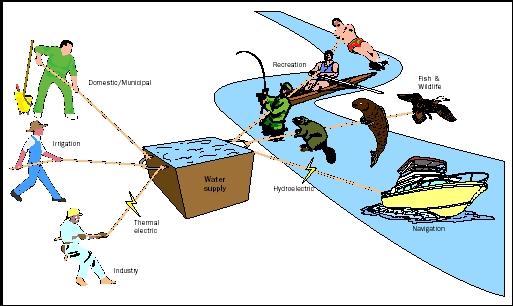 The diagram above depicts a conflict or tug-of-war between the offstream and instream water uses. Offstream uses (left) are those where water is taken from its source by pumping or some diversion method. Instream uses (right) are those in which the water remains in place and refers normally to streams and not ground water. Conflicts occur among various water uses in areas where the supply is limited. Availability of usable water decides where development occurs and water must be in sufficient supply otherwise it cannot take place. |
|
